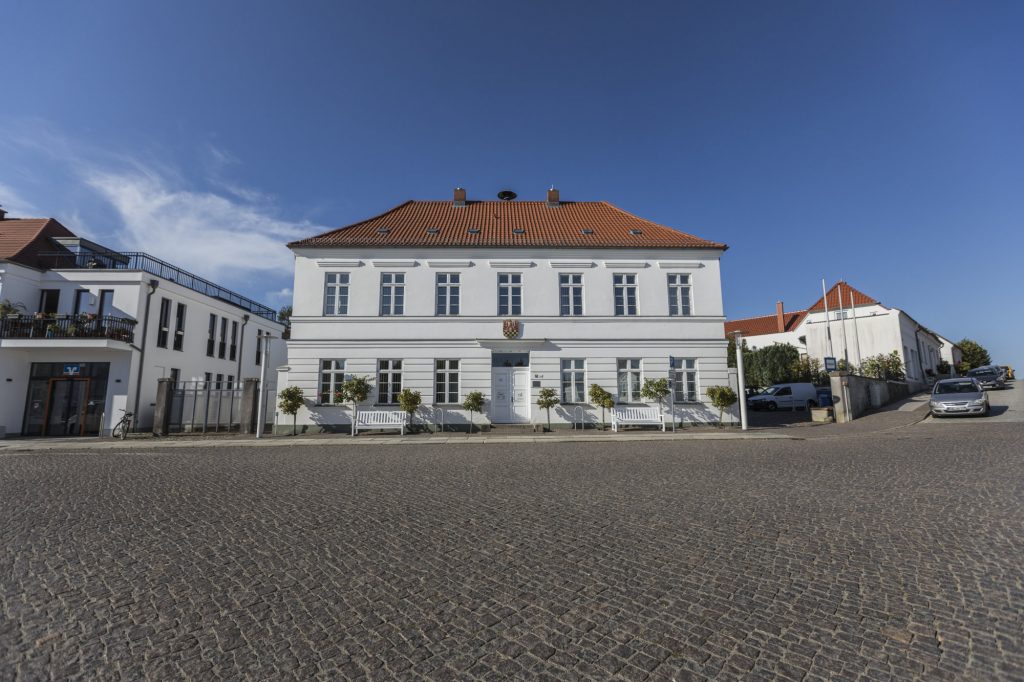
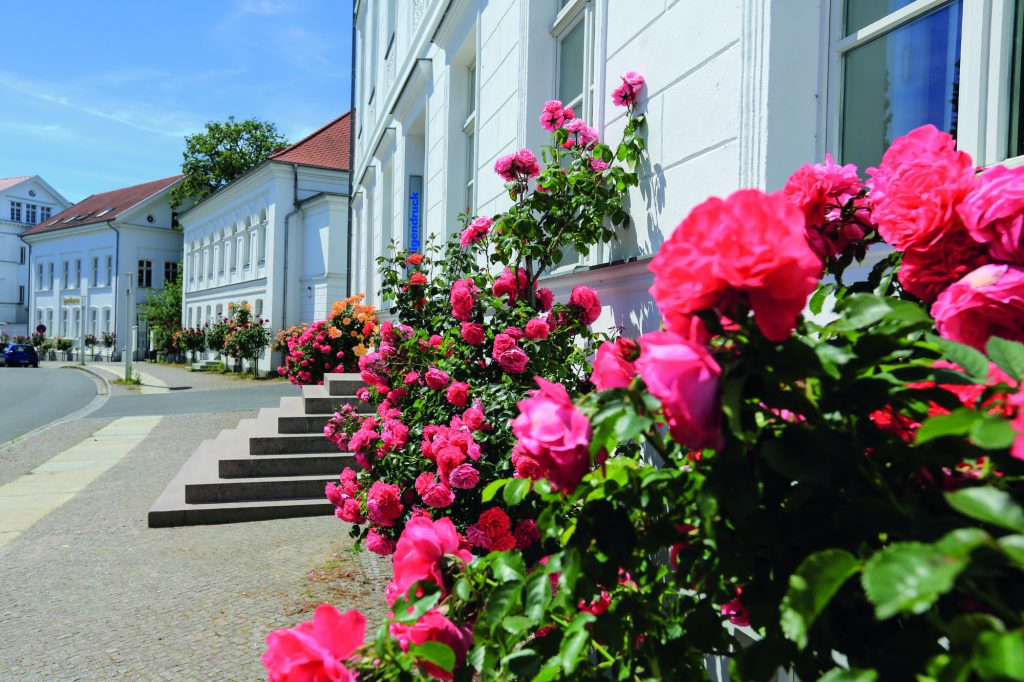
From 1810, when Wilhelm Malte zu Putbus founded Putbus as the youngest northern royal town, (with an Italian flair), and since 1997 as a state recognised place of convalescence and retreat, and still today, Putbus has carried the epithets ‘white town’ and ‘rose town’.
As prescribed by Prince Malte in his time; today’s town fathers and preservation authorities take care of the town centre’s classical character with its gleaming white houses and typical rose bushes planted in front of them. By establishing the first warm sea water bathing house in 13 Alleeestraβe - today a clock and musical instrument museum, Putbus opened as Rügen’s first seaside resort as early as 1816. Because of its success, in 1818 Prince Wilhelm Malte gave orders to build, in nearby Lauterbach, the impressive Friedrich-Wilhelmsbad. It was also built in the classical style and is today known as Haus Goor. A perfectly straight lane was built to connect the bathing house with the castle, from which all changes affecting the town originated.
The once baroque castle, which was altered into the classical style in about 1830 following drafts and designs by Johann. G. Steinmeyer, was sadly destroyed in the 1960’s.
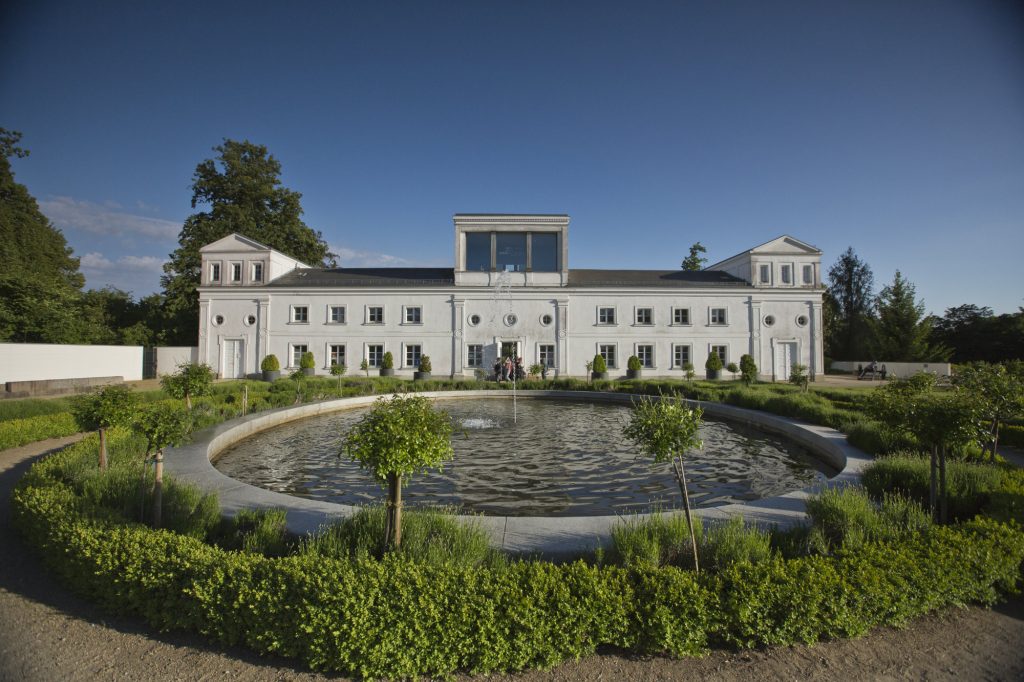
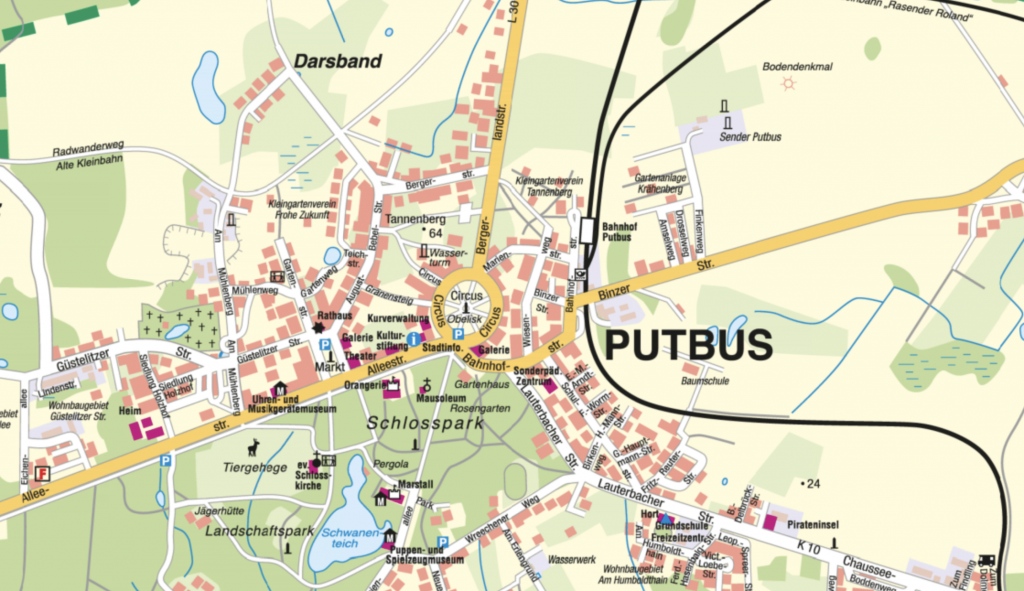
Even today, impressive buildings such as the Marstall (stables), Pergola, Orangerie, and the Prince Wilhelm Malte Memorial in the Schlosspark of Putbus, remind us of the town’s origins.
Architecture of the town of Putbus
The start of building activities in Putbus took place in Alleestraβe. After that, the market , August-Bebel Straβe and the Circus were developed. Most houses, more or less preserved and some already restored, date back to the establishment of the town. Some of the most significant buildings include the former Fürstenhof; the Pädagogium; the town hall (Rathaus) and the theatre. Designed by W. Steinbachs and built between 1819 and1821, the theatre provided seating for 500 people. In the second half of the 19th century, the theatre was extended and partially altered in 1952/53. It remains Rügen’s only theatre.
Once a place where noble guests gathered, the theatre of Putbus is still well loved by the people of Rügen and also by holiday makers. In the past many visitors spent hours on coaches or made long trains journeys in order to see performances.
1992 saw a temporary stop to all events. The theatre was in desperate need of fundamental restoration. At first only minor repair work had been planned but during roof and façade renovation, more and more damage appeared.
Six years passed and 8 million euros was invested in the theatre renovation. Original drafts were used for the layout of the theatre.
The theatre reopened ceremoniously on 2nd May 1998. The wide variety of events
and performances has been maintained.
The buildings in the park also belong to the list of architectural buildings of note:
- The castle church, originally built as the health salon between 1844 – 1845, was rebuilt as a church in 1891-1892.
- The Orangerie, built as a green house and used until 1945 to adapt exotic trees and protect sensitive plants in winter. Today the Orangerie is an exhibition centre.
- The mausoleum was built in 1867 in a new-gothic style as a burial place for the royal family.
- The Marstall (stables) were built in 1824 and is now used for cultural purposes.